6.8410: Shape Analysis (Fall 2026)
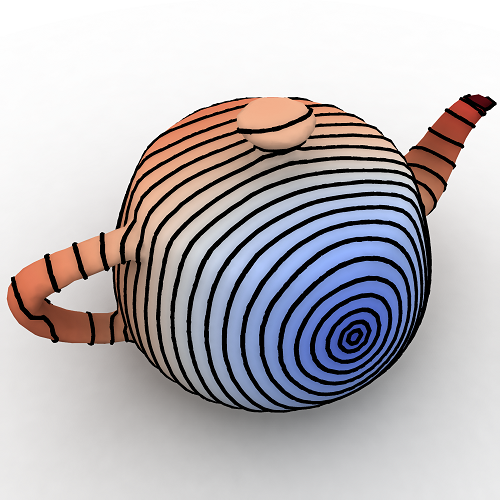
Description:
Introduces mathematical, algorithmic, and statistical tools needed to analyze geometric data and to apply geometric techniques to data analysis, with applications to fields such as computer graphics, machine learning, computer vision, medical imaging, and architecture. Potential topics include applied introduction to differential geometry, discrete notions of curvature, metric embedding, geometric PDE via the finite element method (FEM) and discrete exterior calculus (DEC); computational spectral geometry and relationship to graph-based learning, correspondence and mapping, level set method, descriptor, shape collections, optimal transport, and vector field design. (catalog listing)
Logistics:
Time: Monday/Wednesday, 2:30pm-4pm
Location: 32-124
Staff:
Instructor: Justin Solomon, office hours Wednesdays 10am-12pm (32-D460)
TA: Madelyn Anderson, office hours Tuesdays/Thursdays 12pm-1pm (24-319)
Online resources:
We will be using a number of online tools. All of these should be available for self-enrollment for any @mit.edu email address.
- Assignments should be submitted on Gradescope.
- Ask questions and discuss course-related content on Piazza.
- Check the spreadsheet below for the course schedule.
Policies:
- All items below must be completed to pass 6.8410:
- There will be five homework assignments, cumulatively worth 30% of your grade.
- Quizzes will be worth 30% of your grade. On the Monday or Tuesday after each homework is due, there will be a 30-minute, hand-written quiz in lecture; see the schedule spreadsheet at the bottom of this page for exact quiz dates. Quiz questions test understanding and completion of the most recent homework, possibly along with some content from the last few lectures. For students whose accommodations include extra time on exams, we will establish a regular alternative quiz time (likely the afternoon of the same day as the quiz).
- You will complete a course project worth 40% (instructions below).
- There will be no final exam; the quizzes take its place.
- Our goal is to present this exciting set of highly-technical tools in an approachable and intuitive fashion. Your feedback is needed to calibrate. For this reason, ±5% can be rewarded for course participation, through engagement in lecture, discussion in office hours, and/or contribution to discussion online.
- Assignments must be submitted by 8pm on the listed due date. You will be permitted a total of three late days over the course of the semester, measured in periods of 24 hours. Beyond this, late assignments will lose 25% credit per day (additively).
- Collaboration on homework is permitted, but final writeups/implementations must be individual students' work. The final project can be completed in groups.
AI policy:
- Homework: You may use AI tools as a tutor and to discuss general ideas and directions related to the homework. We expect you to formulate and write up your homework solutions yourself, without the use of AI tools.
- Project: AI tools may be used on the course project. Projects that use AI tools will be judged on the human contributions to the project, which should be articulated clearly in the writeup.
- Acknowledgment: In both cases, any use of AI tools must be acknowledged in the relevant writeup, with details on exactly how the tools were used.
Course notes and other materials:
In this offering of 6.8410, Justin is attempting to continue writing lecture notes that cover the first fraction of the course. Please post errata and suggestions on Piazza; Justin promises not to be offended by constructive criticism. Chapters will be posted as individual links below:
- Chapter 1: Introduction
- Chapter 2: Mathematical Background
- Chapter 3: Curves
- Chapter 4: Surfaces
Assignments:
- Final project: instructions; final paper template
- Homeworks
Slides:
- Topic 1: Introduction
- Topic 2: Linear and Variational Problems
- Topic 3: Curves
- Topic 4: Surfaces
Schedule:
The following is a highly tentative lecture schedule for 6.8410. It will be updated dynamically as the course proceeds. The list of topics is ambitious and likely to be shortened; if there are topics you feel strongly should be included/emphasized/added, feel free to contact Justin with this information.