MASSACHVSETTS INSTITVTE OF TECHNOLOGY
Joint Subject Offering: 6.5160J, 8.351J, 12.620J
Classical Mechanics:
A Computational Approach
Fall 2024: This is the last time this class will be offered!
Jack Wisdom, wisdom@mit.edu, 54-414, x3-7730
Gerald Jay Sussman, gjs@mit.edu, 32-G514, x3-5874
Content:
We study the fundamental principles of classical analytical mechanics.
Subjects: The Lagrangian formulation. Action and variational
principles. Hamilton's principle. Conserved quantities. Hamiltonian
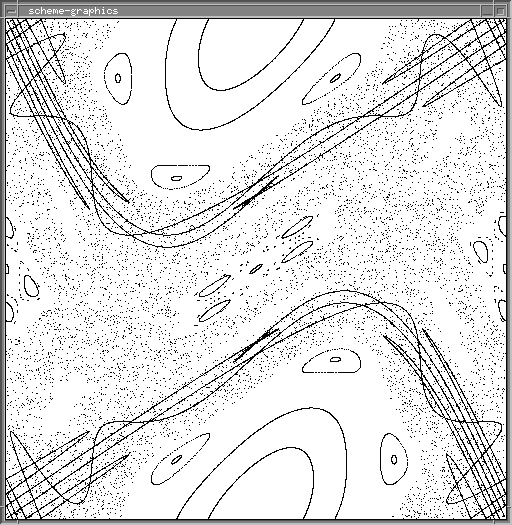
formulation and canonical equations. Surfaces of section. Canonical
transformations and generating functions. Hamilton-Jacobi theory,
Liouville's theorem and Poincare integral invariants.
Poincare-Birkhoff and KAM theorems. Invariant curves. Canonical
perturbation theory using Lie transforms. Nonlinear resonances.
Resonance overlap and transition to chaos.
Ideas are illustrated and supported with examples from recent
research.
We make extensive use of computing to capture methods, for simulation,
and for symbolic analysis. Formulation in a computational framework
encourages clear thinking and active exploration. }
This subject awards G-LEVEL Graduate Credit, however the subject
is appropriate for undergraduates who have the prerequisite experience.
Undergraduates are welcome.
Prerequisites: 8.01, 18.03, programming experience
Lectures: MWF at 1300 ET (1:00PM) in 54-823
Computer Lab: Wednesday evenings, 1900-2200 ET (7--10 PM), in 54-824.
Units: 3-3-6
Teaching plan:
Professors Jack Wisdom (EAPS) and Gerald Jay Sussman will teach
this class entirely in person. We
will run our evening laboratory, each Wednesday from 1900--2200
EDT (7:00PM--10:00PM). We expect students to actively
participate in all of the meetings.
We also invite students individually and in groups to drop in
to discuss problems with us at other times.
Grades:
This is an advanced class. There are no quizzes. Grades are entirely
determined by the work that students do in weekly problem sets,
attendance and participation in the class and in the laboratory, and
some more extensive projects. In the evening laboratory we hang out
with the students, engage in discussions, and we try to help with the
weekly work. We encourage students to work together and help each
other learn the material, but each student must prepare an individual
report on the work done on the problem sets and projects. Each
student must report on the help that they gave to and received from
other students.
Textbook:
Structure and Interpretation of Classical Mechanics, second edition,
MIT Press, 2014, ISBN: 978-0-262-02896-7
Mechanics Book (HTML), second edition
Errata for the Mechanics Book, second edition .
Structure and Interpretation of Computer Programs, second edition (HTML)
Red Tape Memo
Don't Panic!: A guide for the perplexed (software setup).
Assignments
Beginner notes
Edwin cheat sheet
Scmutils manual
Graphing notes
Software
If you want to install the software on your personal computers
see here.
We will also make our software available on Athena.
Our MIT Press book on differential geometry!
Software for Differential Geometry
This software is now automatically available as part of our mechanics system,
if you get the latest version here.