Using Probabilistic I/O Automata to Improve the Analysis of Cryptographic Protocols
by Ran Canetti, Ling Cheung, Dilsun Kaynar, Moses Liskov, Nancy Lynch, Olivier Pereira and Roberto Segala
Modelling cryptographic protocols and analysing their
security is a tricky business. On the one hand, valid modelling and
analysis must address the concurrency aspects of asynchronous
distributed systems, with potentially adversarial scheduling of events.
On the other hand, realistic analysis must accommodate the fact that, in
most interesting cases, it is impossible to completely prevent
successful attacks against the protocol. Instead, we can only bound the
success probability of attacks that use a bounded amount of
computational resources, based on underlying computational hardness
assumptions.
Cryptographic modelling and analysis is typically complex,
involving many subtleties and details, even when the analysed protocols
are simple. Furthermore, analysis is handwritten and often tedious to
verify. These factors make the security analysis of cryptographic
protocols susceptible to errors and omissions.
This project demonstrates how to cast cryptographic
security analysis of distributed protocols within the Probabilistic I/O
Automata (PIOA) framework of Lynch, Segala and Vaandrager. This
framework provides standard tools for arguing rigorously about the
concurrency and scheduling aspects of protocols. It supports reasoning
with multiple levels of abstraction and has a well-defined notion of
composition. Consequently, using the PIOA framework can help in making
cryptographic analysis more precise and less susceptible to errors.
In the context of this project, we aim to develop general
techniques applicable to the analysis of a wide range of security
protocols that exhibit various levels of complexity in terms of
adversarial behavior or the use of cryptographic primitives. As a first
step, we are currently analysing a relatively simple protocol, the
two-party Oblivious Transfer (OT) protocol, in the presence of a
semi-honest adversary (essentially, an eavesdropper). The particular OT
protocol we are studying is the classic protocol by Even, Goldreich and
Lempel, which uses trapdoor permutations (and hard-core predicates for
them) as the underlying cryptographic primitive. For the underlying
cryptographic notion of security, we start from Canetti’s Universally
Composable Security.
In spite of the relative simplicity of the investigated
case, the exercise is non-trivial and requires addressing a number of
fundamental issues. These include modelling resource-bounded
computations, resource-bounded adversarial behaviour and scheduling,
combining non-deterministic and probabilistic choices, and modelling
computational hardness assumptions. Some of these are beyond the reach
of the existing semantic theory of probabilistic I/O automata. This
project therefore involves using not only probabilistic I/O automata in
security protocol analysis but also extending the basic theory to
address the requirements of such analysis.
Approach
One common approach to simplifying cryptographic protocol
analysis and improving its correctness is to model cryptographic
primitives as ‘symbolic operations’, or ‘ideal boxes’, which represent
the security properties of the primitives in an idealized way that
involves no error probabilities or computational issues. This approach
is quite promising; however, it does not completely remove the need for
cryptographic analysis of protocols. Rather, it only proves the security
of the overall protocol by assuming the security of the cryptographic
primitives in use. One still has to prove the security of these
primitives in a fully fledged cryptographic model with all its
subtleties. Our project proposes an alternative (in fact, complementary)
approach to making cryptographic protocol analysis more systematic and
rigorous, and thus less susceptible to errors.
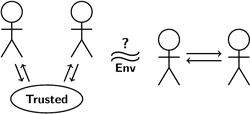
We benefit from the powerful proof techniques that have
traditionally been used within I/O automaton frameworks. In particular,
we express the system at multiple levels of abstraction, where the
highest level in the abstraction hierarchy represents the specification
of the protocol and the lowest represents the real-world system running
the protocol. We demonstrate simulation relations between these levels
that allow us to conclude that the real-world system implements the
abstract specification. The composition operation for PIOAs makes it
possible to separate the specification of correctness and security
requirements of the protocol, and to express the real-world system
naturally, as a composition of logically separate units interacting with
another.
Future Work
We would like to assess the techniques we have developed so
far in the analysis of more complex protocols. This complexity arise
through more powerful adversaries, more complex interaction patterns
between the components of the protocol, or more subtle uses of
cryptographic primitives.
One limitation of our current approach is that the existing
scheduling mechanism is oblivious to execution histories and hence
significantly limits the capabilities of the adversarial components. We
will investigate how our assumptions about task-PIOAs and scheduling
mechanisms can be relaxed to enable the analysis of a larger class of
protocols.
Once our modelling and proof techniques become more general
and established, we can focus on mechanizing our proofs with
interactive theorem-provers, or even automate some or all of the proof
steps.
Please contact:
Olivier Pereira, Université catholique de Louvain (FNRS), Belgium
Tel: +32 10 47 91 63
E-mail: pereira dice.ucl.ac.be