 The capabilities of the toolkit can be divided into three categories:
The capabilities of the toolkit can be divided into three categories:
 The Site: photo.net was built by Philip
Greenspun to share his photographs and photographic knowledge.
It has grown, with the support of Philip's programming expertise,
into an active community of photographers. (There are currently
4,874 registered users of photo.net who have stated an interest
in photography.) The Arsdigita Community System Toolkit grew out
of the software Philip built to support photo.net. Above you can
see the front page of photo.net which lists all the database-backed
services available to its users. All of Philip's
ideas for the design of collaborative communities have been tested
and refined during their active use in the photo.net community.
Therefore the software you see now contains all the best ideas that
have survived
many years of use and abuse by thousands of enthusiastic photo.net users.
The Site: photo.net was built by Philip
Greenspun to share his photographs and photographic knowledge.
It has grown, with the support of Philip's programming expertise,
into an active community of photographers. (There are currently
4,874 registered users of photo.net who have stated an interest
in photography.) The Arsdigita Community System Toolkit grew out
of the software Philip built to support photo.net. Above you can
see the front page of photo.net which lists all the database-backed
services available to its users. All of Philip's
ideas for the design of collaborative communities have been tested
and refined during their active use in the photo.net community.
Therefore the software you see now contains all the best ideas that
have survived
many years of use and abuse by thousands of enthusiastic photo.net users.
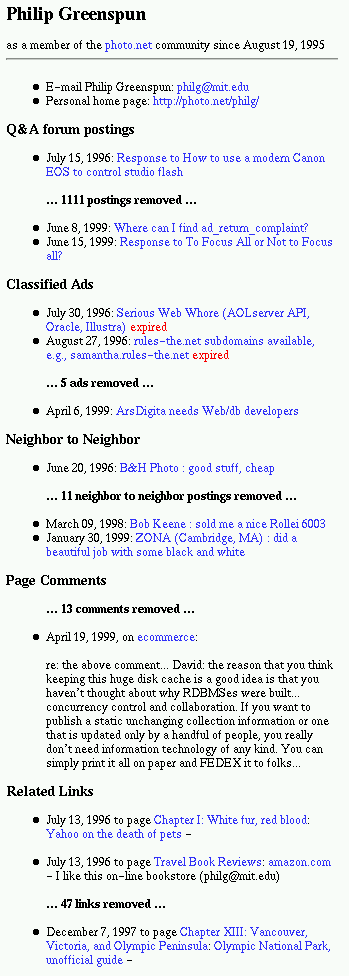
Feature of Note:
Community Member Histories.
photo.net is more than a on-line photography book, because it collects users reactions and supports user's discussions. It is also more than a photography comment/discussion system: it is a community as well. The difference between a discussion group and a community is that members have a chance to learn from each other's history as well as from the most recent contribution. Thus the most important part of the community system in the community member history pages. On that page every contribution by a particular user is displayed in one place. From this page one can learn the interests, habits and personality of another user. At the left, we see (an abridged view) of the community member history for the community's oldest member. If you wish, you can also view the complete version The view of this page available to an administrator offers even more information about the user: contact information, demographics, a record of all the searches initiated by the user, a list of the mailing lists the user has signed up for, and a record of all the static pages the user has viewed while registered on the site.
It is this ability of the community system to record a comprehensive
picture of all the activities of a single user that is probably its
most innovative and useful feature. In the next few sections we
will show a number of different examples where this capability
is put to use in a some very practical contexts.
We leverage our local innovations globally.
We are a community committed to increase value for our customers and ICN by creating and re-applying leading-edge solutions.
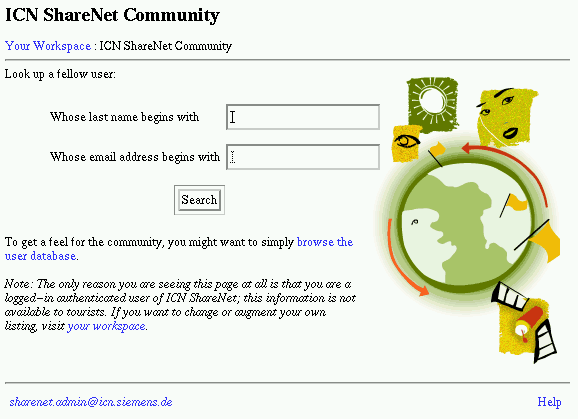
The Sharenet site provides a user directory that allows users to search or browse to quickly find another user of the system. The directory leads to a Community Member page for each user, like the one shown above for photo.net. However in this case it lists all the knowledge management sales/service activities of the user in question. In this way a salesperson at Siemens can easily keep track of the activities of the other salespeople, facilitating collaboration and group coordination. That much less time would have to be wasted in long Dilbert-esque meetings!
Also note the graphic at the left of the image above. The community system toolkit now supports graphic decoration to spice up dull text-only pages, without impeding navigation or the speed of page loading.
The text on the image above refers to the users workspace. In the next example we will show how the users workspace can be used and customized in a web project.
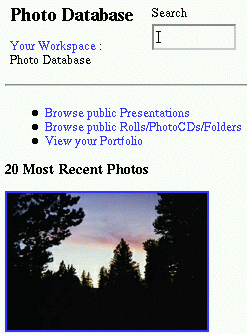 The Site:Philip taught a web design course at MIT in
which students built their own projects on top of the Arsdigita Community
System. One of the projects is a photograph management service.
Here is the description this site gives for itself:
The Site:Philip taught a web design course at MIT in
which students built their own projects on top of the Arsdigita Community
System. One of the projects is a photograph management service.
Here is the description this site gives for itself:
The Photography Management Service allows photographers to organize and share their photos.
Photos are jpgs, gifs, and Kodak PhotoCD files (.pcd) uploaded through your browser. The Management service lets the photographer save information (e.g. caption, camera and film type, date) about each photo as it is uploaded. The system creates thumbnails that can be accessed on the WWW that link back to this information.
Photographers can share their photos in two ways. First, individual photos can be made available to the public for browsing or searching. Second, the photographer can create a presentation. A presentations exhibits a selected group of photos about a topic for a specific audience.
Photographers organize and manage their portfolio of photos and presentations. In their portfolio, photographers can store additional information about each photograph with custom data fields.
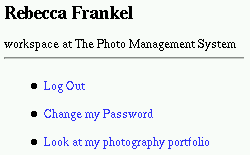
Feature of Note: Personal Workspace Customization
Each user has a general community
member workspace in which they can view or update their contact information,
change their password, or edit their email alerts. Specific applications
can add entries to a user's workspace, to allow them application-specific
capabilities. In this case, because I have started my own personal
portfolio in the Photo Management Service, I get a handy new link in my
workspace which allows me to check out the state of my personal photography
portfolio.
 Since 1995, we have built and operated six sites that accept credit card
orders from consumers. We are now operating
ecommerce services with our standard ArsDigita Community System toolkit
because it turns out that there is almost always a substantial need for
collaboration between customer service staff and customers, e.g., to
provide technical support. We've always done the obvious things like
relationship management and customer value management, but since 1998
we've extended our software with an eye toward achieving
"mass customization, 1:1 marketing, disintermediation, and whole product
management" (requirements from one of our customers).
Since 1995, we have built and operated six sites that accept credit card
orders from consumers. We are now operating
ecommerce services with our standard ArsDigita Community System toolkit
because it turns out that there is almost always a substantial need for
collaboration between customer service staff and customers, e.g., to
provide technical support. We've always done the obvious things like
relationship management and customer value management, but since 1998
we've extended our software with an eye toward achieving
"mass customization, 1:1 marketing, disintermediation, and whole product
management" (requirements from one of our customers).
He explains this last comment in somewhat more detail in the ecommerce chapter of his book:
Companies that are selling direct for the first time will immediately
realize that they now have access to their dream data. They can figure
out, down to the individual consumer, who is buying what and how often.
About two days after the business folks realize this, they will turn to
the nerds and say "Build us a lifetime customer value management
system."
The "lifetime" in the above phrase reflects the fact that you have to
engineer the system to track particular customers' activities over many
years. As soon as Joe Smith shows up on the site, you need to know how
many times this person has placed an order, returned a product, demanded
a refund, come to the site and not ordered, etc.
The engineering in a system like this is a straightforward matter of SQL
tables and Web scripts. What's hard are the business rules. Here are
some examples:
As a Web developer, I don't think there are customer value management
technical issues that are distinct from those associated with
personalization on non-commercial sites.

Therefore all the community member tracking functions I have been showing in the context of non-commercial sites are as much or more useful to commercial money-making sites. In the next few sections I will show off examples of user-tracking in the context of ecommerce.
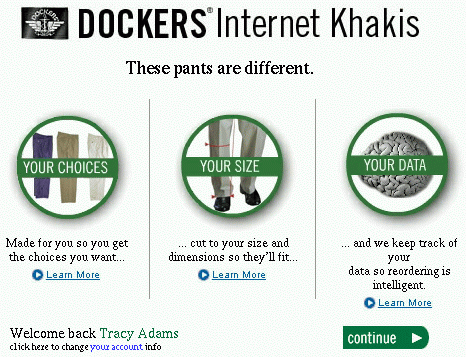
The Site: Arsdigita built a site for Levis that allowed users to order khakis custom-built to their measurements. Here is the description the site itself gives of the capabilities it offers:
Your Choices:
Your Size:
Your Data:
You need to get exactly what you
want in an effortless way, and so
we've given you the choices you
care about: pleats, cuffs, fabric and
color. We take care of everything
else, so whatever combination you
choose adds up to a classic pair of
khakis.
You need to know that these pants
are going to fit, and that's why
DockersŪ Internet Khakis lets you
choose waist and length sizes to
the 1/2". We also use your
individual measurements, weight,
height and shoe size, to choose a
pattern that is the best match to
your dimensions.
When it's time for your next pair,
we base the fit on an existing pair.
If you want a pair that's a bit
looser, or longer, it's no problem. In
fact, we remember every pair of
DockersŪ Internet Khakis that
you order so you can duplicate or
adjust them.
One of the managers at Levi's who ran
this project gave a talk in which he made a comment that made a deep
impression on me. He was telling the story of the process of designing
a factory that was capable of taking custom orders and delivering
finished pants within a period of time the customer was reasonably
willing to wait.
 He said he had to fight against the entrenched
mindset of people trained in factory-design that every process in the
factory must be done as efficiently and cheaply as possible to achieve
the maximal productivity from the factory. "Look," he told the design
people, "if you make a pair of pants in the most beautifully efficient
manner, and then it goes and sits in warehouse for two months, and
then sits on a store shelf for three months, then goes down to the
bargain basement for two weeks, then gets returned to the warehouse to
sit for another few months, and finally ends up in discount store to
be sold for a fraction of its value, you have NOT increased the
productivity of this factory." His point was, even though the factory
is somewhat less efficient because every pair of pants it made is
cut to a different pattern, it is in fact much more productive
because it has a nearly total guarantee that every pair of
pants it made would be sold immediately. In fact, the factory
gets the money for the pants from the customer before even they
begin to cut the fabric. This seems to me to be the story of the real
productivity revolution that the internet will make possible.
He said he had to fight against the entrenched
mindset of people trained in factory-design that every process in the
factory must be done as efficiently and cheaply as possible to achieve
the maximal productivity from the factory. "Look," he told the design
people, "if you make a pair of pants in the most beautifully efficient
manner, and then it goes and sits in warehouse for two months, and
then sits on a store shelf for three months, then goes down to the
bargain basement for two weeks, then gets returned to the warehouse to
sit for another few months, and finally ends up in discount store to
be sold for a fraction of its value, you have NOT increased the
productivity of this factory." His point was, even though the factory
is somewhat less efficient because every pair of pants it made is
cut to a different pattern, it is in fact much more productive
because it has a nearly total guarantee that every pair of
pants it made would be sold immediately. In fact, the factory
gets the money for the pants from the customer before even they
begin to cut the fabric. This seems to me to be the story of the real
productivity revolution that the internet will make possible.
Feature of Note: Personalized Ecommerce
This kind of product personalization would not be possible without an ecommerce system built around a powerful users model. My friends were terribly impressed by the tag in the pocket of my pants, but a pair of pants with a serial number in the pocket is not in itself so impressive. What they were really impressed by, I think, was the idea that there was a computer somewhere that knew what kind of pant I wore, so that next time I wanted new pants I could simply ask for "another one like that but a bit shorter." Its funny, because in general people seem terribly threatened by the idea that computers will know stuff about them; but in this case everyone I met seemed to think it was wonderful. I suppose when people think of mysterious computers out there that know about them, they think of the IRS or the FBI, neither of which carry very pleasant associations. It is a new ideas to people that computers can also use their data to do "mommy tasks" like "my pants are uncomfy: get me a better pair." Convince your customers that your services will act like mommies to them, and I think you will have their loyalty forever.


Feature of Note: User Tracking for Customer Service
Notice that this image looks very much
like the community member history page seen in the first example. (It
looks even more like the administrator's view of that page). But this
time we are looking at a customer service summary page for an ecommerce site.
The key idea is that these two applications are basically the same.
Just as a member of a photography community might like to see all the
contributions made by another member of the community listed
together in one place,
a customer service representative will want to see all the actions of
a customer summarized on one page. This similarity may be no accident:
in some sense a seller and a buyer are part of a community trying
to accomplish something together.
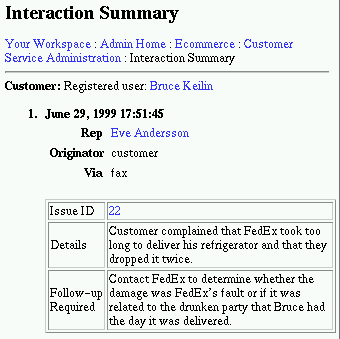 This (fictional) customer seems to be causing problems. At
the right we see the top portion of his interaction history.
Above we see that his credit card has been rejected once and
only grudgingly accepted the second time (avs stands for
Address Verification Service; authorized_minus_avs
means that his credit card number matched but his address didn't).
I think he may soon qualify
for the David Difficult category.
This (fictional) customer seems to be causing problems. At
the right we see the top portion of his interaction history.
Above we see that his credit card has been rejected once and
only grudgingly accepted the second time (avs stands for
Address Verification Service; authorized_minus_avs
means that his credit card number matched but his address didn't).
I think he may soon qualify
for the David Difficult category.
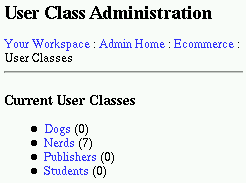
 Feature of Note: User Classes
If you are running a ecommerce
site, you may want to keep track of categories of customers. One
obvious reason is that you may wish to offer different customers
different prices! Without this feature in an ecommerce system, many
businesses could not afford to sell their products on the web
at all. Here we see a very silly example of this feature in
action (remember this is a development server: this is not real data).
When I first come to the site I am offered a chance to buy Philip's book for the low, low price of $39.95.
Later I beg Eve to allow me into the prestigious and selective "Nerds" group.
 After much begging, she grants my request.
When I return to the page listing the price of Philip's book,
I see that
"Nerds" are offered a special discount price.
If I did not know the group existed, I would never
have known of the special price. (This whole scenario
is fake, by the way, though if you are nice to Philip
or go to his seminars, he will give you a copy
of his book at Nerd prices.)
After much begging, she grants my request.
When I return to the page listing the price of Philip's book,
I see that
"Nerds" are offered a special discount price.
If I did not know the group existed, I would never
have known of the special price. (This whole scenario
is fake, by the way, though if you are nice to Philip
or go to his seminars, he will give you a copy
of his book at Nerd prices.)
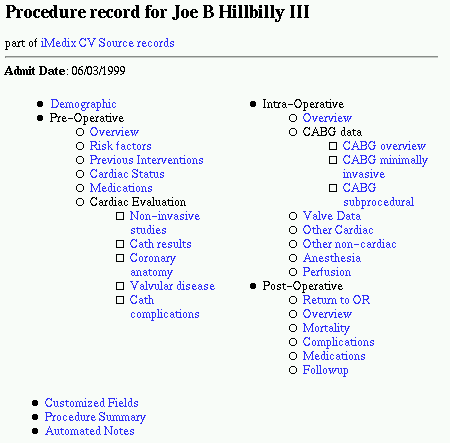 The Site: Arsdigita built an outsourced
medical record system for cardiac surgeons for a company called iMedix.
To view a demo of this system, log in with email=teadams@mit.edu
password=demo. The system is intended
to replace hundreds of hospital information systems with a
single Unix machine. The project was a stunning vindication of
ArsDigita's architecture and strategy, for with only a few
programmers on the project they finished the system
months ahead of the competitors. (The lead programmer on
the project, Tracy Adams, is a brilliant programmer and a tremendously hard
worker. She was the one who masterminded this site; I would show you a picture
of her if I had one.) At
the right you can see an image of one patient record from this system.
As you can probably guess from this image, this system handles huge
amounts of detailed medical data. Here is a description of
the system that appeared in a local newspaper article:
The Site: Arsdigita built an outsourced
medical record system for cardiac surgeons for a company called iMedix.
To view a demo of this system, log in with email=teadams@mit.edu
password=demo. The system is intended
to replace hundreds of hospital information systems with a
single Unix machine. The project was a stunning vindication of
ArsDigita's architecture and strategy, for with only a few
programmers on the project they finished the system
months ahead of the competitors. (The lead programmer on
the project, Tracy Adams, is a brilliant programmer and a tremendously hard
worker. She was the one who masterminded this site; I would show you a picture
of her if I had one.) At
the right you can see an image of one patient record from this system.
As you can probably guess from this image, this system handles huge
amounts of detailed medical data. Here is a description of
the system that appeared in a local newspaper article:
AATS, NEW ORLEANS, LA (Monday, April 19, 1999) - iMedix, Inc. today announced it is the first - and only - clinical outcomes software vendor to receive the first of two stages of certification by the prestigious Society of Thoracic Surgeons (STS) for its web-based product - CV Source.
iMedix enables hospitals, surgeons and other cardiac caregivers to collect, analyze and compare clinical outcomes via the Internet using its STS certified product, CV Source. One of the many benefits CV Source delivers is to help clinicians establish best practices and provide high quality cardiac care at a lower cost. CV Source is the only product that is certified to be in compliance with the most recent STS data collection standards.
"We are thrilled to be the first vendor in the industry to offer a solution that is recognized and accepted for the essential first stage of certification by the Society of Thoracic Surgeons. This is a very significant validation for our customers, because it shows that the STS has tested and approved of our web-based application model for collection and analysis of cardiovascular surgery data," said Ern Blackwelder, CEO of iMedix. "This level of recognition from such an elite professional society serves as a springboard for us to reach our ultimate goal - to lead this industry with a technology that provides unparalleled benefits for our customers and establishes us as the database innovator and pioneer."
CV Source is the industry's first, and only Internet-based solution that provides hospitals, physicians, and other health professionals with real-time clinical outcomes data collection, , analysis, and comparative reporting tools via web-based technologies, to help dramatically improve cardiac patient care.
The STS has many stringent requirements for certification of software. Benefits to members include having confidence that the products offer features such as improved and simplified core data sets, better automatic internal data quality checks, standardized export capabilities to make outcomes data more accessible and useful, and a new standard method for data harvest.
 Feature of Note:
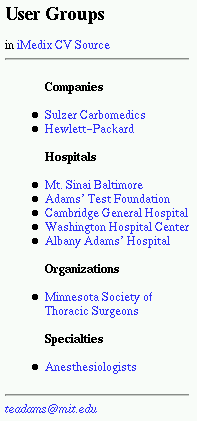
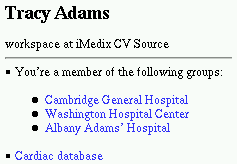
Because the system contains so much data, users must have some way of finding the information they need. One way is to join a user group. As you can see above, there is a user group defined for each hospital, company, organization or specialty using the system. When a person joins a user group, that group is listed on the users workspace. Notice, here is another example of workspace customization like the one we saw earlier for the photo database! The group link leads to information of concern to that particular group. For example, the link to Washington Hospital Center leads to the patient records for patients registered at Washington Hospital Center (like for instance Mr. Hillbilly shown above).
 Another Feature of Note:
User Group Roles and Permissions
Much of the data in the iMedix CV source is sensitive and
valuable. It is important to keep track of who is allowed
to view, rearrange or modify the data. This is accomplished
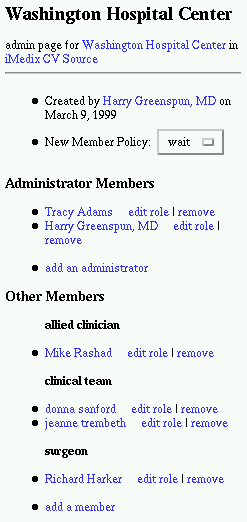
using the user group roles and permissions system. Each user
group has a number of defined roles. Users within the group
are assigned to various roles. Each role has a set of permissions
associated with it: what the users within that particular group
are allowed to do. In the image to the right you see a number of the
roles defined within the Washington Hospital Center. Below you can
see a table of the various permissions associated with each of the roles.
| Role \\ Action | administrate | clinical_entry | data_report | data_review | demographic_entry |
|---|---|---|---|---|---|
| administrator | Allowed | Allowed | Allowed | Allowed | Allowed |
| allied clinician | Denied | Denied | Denied | Allowed | Denied |
| clerical support | Denied | Denied | Denied | Denied | Allowed |
| clinical team | Denied | Allowed | Denied | Allowed | Allowed |
| data analyst | Denied | Denied | Allowed | Denied | Denied |
| data entry | Denied | Allowed | Denied | Allowed | Allowed |
| surgeon | Denied | Allowed | Allowed | Allowed | Allowed |
 In the past couple of examples we have shown how the community
tracking capabilities of the ArsDigita Community Toolkit were
used in ecommerce and medical record applications.
Now we want to point out another practical business-oriented
use of a community system: to manage the community of workers
within the business itself. Philip considers the development of
community tools for internal business use one of the major frontiers
of development for Arsdigita in the future:
In the past couple of examples we have shown how the community
tracking capabilities of the ArsDigita Community Toolkit were
used in ecommerce and medical record applications.
Now we want to point out another practical business-oriented
use of a community system: to manage the community of workers
within the business itself. Philip considers the development of
community tools for internal business use one of the major frontiers
of development for Arsdigita in the future:
Feature of Note:
More examples of Workspace Customization and Personalization
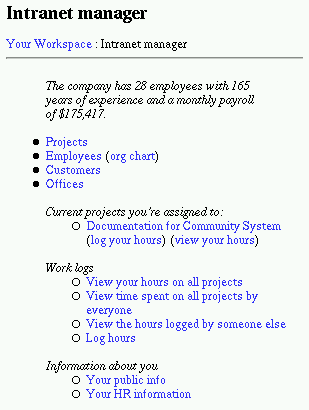
Note that the page seen at left is another example
of a specialized application linked from my personal workspace.
The system that generated this page knows who I am: it knows
what projects I am assigned to and offers me links to my personal
information.
 In the last section we have seen how the Community System
provides comprehensive user tracking, grouping and personalization.
However, there is little sense in building a dynamic community
of users without also allowing them to interact with each other.
In this section we will show how the community system
provides support for user interaction.
In the last section we have seen how the Community System
provides comprehensive user tracking, grouping and personalization.
However, there is little sense in building a dynamic community
of users without also allowing them to interact with each other.
In this section we will show how the community system
provides support for user interaction.
Feature of Note: User Interfaces Interoperate
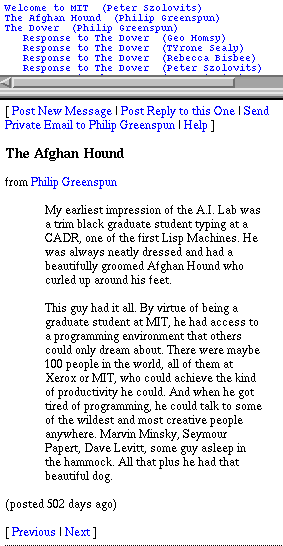
Philip's favorite interface for a bulletin board is the a Question and Answer Format, seen above. However, the same bulletin board can be viewed using a different format, such as the threads interface seen at right. You can see from this examples that the user interfaces interoperate: that is, data entered in one interface can be viewed in another. All the messages in this forum were submitted by users viewing the forum using the Question and Answer interface, and yet it can be made to look like a quite normal threads-based discussion. The postings that were entered using the "Contribute an Answer" button on the page devoted to the question "The Dover" by Philip Greenspun, are given thread-title "Response to The Dover" automatically by the software. Thus they appear as normal-looking threads in a threads interface. If we were going the other way, a message in a threads-based forum that illicited a number of responses would appear in the Q&A forum as a question with all the responses listed below as answers (this would flatten any hierarchy that existed in the responses).
The advantage of the threads interface is that you can look at a summary of all the postings on one screen, with the downside that you can only look at one message at a time. By comparison, the advantage of the Q&A format is that you can look at a whole thread on one screen, with the downside that you have to click back to another page to get the summary of the whole forum. Philip greatly prefers the Q&A forum format, and I am inclined to agree. Since postings are often short, it is a great advantage to have a whole topic on a single page. This advantage far outweighs the disadvantage that less summary information is available on the postings. Usually the list of questions is informative enough. In fact, it is often more informative, because thread summaries are often redundant and silly (they can be taken up by long lists of message titles like "Re:I'm confused" and other such uninformative matter). People asking a question usually put some effort into choosing a question title that is at least a little bit useful to the reader.
 The Site: Hotscience in Cognet
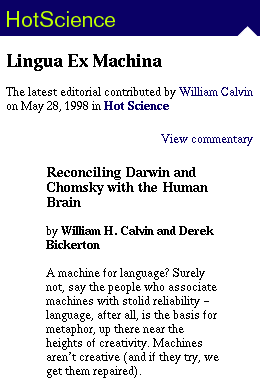
Cognet is a site for a cognitive scientists built by ArsDigita for MIT Press. A section of this site is devoted to a forum called HotScience, in which reviews are posted for discussion. This forum is run using the bboard module, but the interface is slightly altered to accommodate the editorial-and-response style discussion. Here is the description the forum gives of itself:
This is
HotScience, CogNet's monthly interactive editorial.
HotScience promotes critical discussion about issues in the cognitive and brain sciences. Each month, invited contributors share a somewhat controversial take on their current research
Post a response to this months editorial by clicking on the "View Commentary" link.
Feature of Note: Editorial Style Forums
This is a slight variation on the Question and Answer Format: if your "questions" are likely to be long essays for which you wish to garner reader responses, but you don't want new readers to be too distracted by old responses, then the Editorial format is appropriate. The Editorial format emphasizes the "question" and makes the answers available through a "View Commentary" link. At the right we see the example from Cognet, the kind of service for which the Editorial format is appropriate. The Cognet site wants to show off reports from prominent researchers; they want to emphasize the review, while still making the commentary available to readers who care.
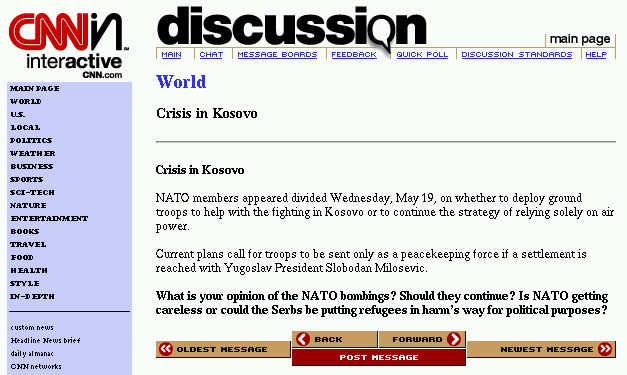
The bulletin board is a versatile system that, like all of Arsdigita's modules, does not particularly depend on the graphic design of its user interface to function properly. As a result, you can superimpose whatever wild ideas your own graphic designers come up with onto ArsDigita's computing infrastructure. The infrastructure will adapt with a minimum of effort.
 The Site: Green Travel Network is a company that
promotes ecotourism and adventure travel. They commissioned
ArsDigita to build a community web site to disseminate information
and promote community among their customers.
The Site: Green Travel Network is a company that
promotes ecotourism and adventure travel. They commissioned
ArsDigita to build a community web site to disseminate information
and promote community among their customers.
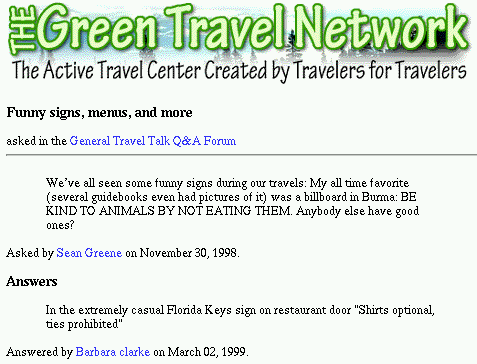 Feature of Note: Recreational Discussion
Sites that provide services to help fill people's free time
may well want to provide discussion forums. People enjoy
sharing stories about the things they do when they are having
fun. In the mean time, they may become interested on the services
the company has to offer.

I founded The Insider's Guide to Law Firms in 1992 for purely personal reasons. I was a third-year law student and was trying to figure out how to identify and get hired at the firm that best matched my interests and personality. I clearly remember late one night in September 1992, I was going through the daily fall routine of law schools nationwide trying to figure out what to do with their lives. After sifting through numerous firm brochures and other similar resources my exasperation was complete. "All these firms look alike," I burst out to fellow classmate, original co-editor, and now husband, Michael Walsh. "I'm sick of hearing about 'collegial' firm atmospheres.
The Insider's Guide to Law Firms is now in its fourth edition and a fifth edition is due out this Fall (although reviews from the guide will be available earlier on this site on a rolling basis as each one is finalized, an advantage the Internet offers over traditional print media). Between the time that I first embarked on The Insider's Guide project and now, the web has been growing by leaps and bounds. In a few short years, this medium has proven its incredible power to bring together people separated by time and space. It is now possible to build communities around common interests and to share information where previously there were insurmountable barriers.
 Having worked at several firms, Mike and I knew they differed dramatically. Moreover, every fall our law school campus buzzed as second- and third-year law students informally exchanged information about their summer experiences at law firms. It is this somewhat intangible information, I believed, that was most valuable to people who were considering working in law firms. But, it requires a wide network of contacts and luck to hear all the stories that people have to tell. As third-year law students, Mike and I decided to collect all these anecdotes, impressions, and pieces of information from our peers not just at Harvard (where we were in school), but across the country, and organize them. Our idea was to provide law students and practicing lawyers an informative, independent source of information on the nation's most well-known firms which was collected and disseminated by law students and associates at the firms rather than by the firms themselves. So was born The Insider's Guide to Law Firms.
When people are trying to build their careers and manage their practical affairs, they can be intensely interested in "insider information" from other people who have gone through the same effort. Repositories of such information can be extremely valuable, as the creator of InFirmation explains below:
Welcome to the Discussion Forum area of
Infirmation.Com. The purpose of this forum is to provide a place for
discussion of topics of particular interest to lawyers and law
students who are evaluating their career options and making career
decisions. It is my hope that in time we will be able to build this
area into a repository of useful advice and experience from "insiders"
who have worked at law firms.
It is my hope that this Discussion Forum will take what was begun with
The Insider's Guide to the next level. Insiders at law firms
and people considering working at those law firms will be able to
communicate directly with each other (as opposed to through
intermediary editors) and will be able to do so immediately (instead
of waiting for materials to be printed and disseminated). This forum
will capture and store participants insights in an organized fashion
making it easier to constantly build a shared knowledge base.
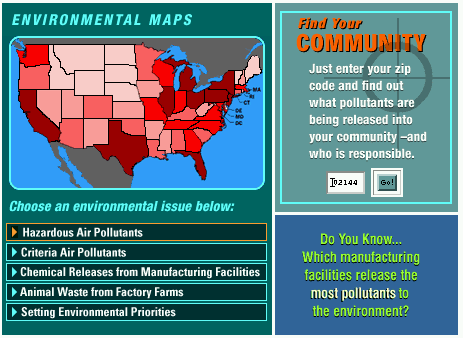
When we first launched Scorecard in April 1998, we had no way to know whether
or not this would be a popular website. After 24 hours and a million attempted
"hits"... we had our
answer...
Scorecard's most popular feature is its "type in
your zip code" approach to finding local information about local
environmental conditions and problems. The site's interactive maps, which let you
click down to a local neighborhood in a second or two, are another popular
pathway. Our goal is to make the local environment as easy to check on as the
local weather. You may not do it all the time, but it should always be at your
fingertips.
The first kind of local environmental information to appear on Scorecard covered
releases of toxic chemicals from industrial facilities,
together with the health effects of the animal
waste from pigs, cattle, sheep, etc., county by county and, in some regions,
farm by farm. We then added information about local environmental priorities, showing what expert panels have identified as
the top environmental problems in particular states and regions, wherever such
studies have been completed.
Now, on the first anniversary of Scorecard's launch, we are taking a major step
closer to answering the most basic question about air pollution that's on most
people's minds: "With this local pollution in my neighborhood, am I safe or
not?" There is still no definitive answer, either on Scorecard or from any
government or public health official. But new estimates from the U.S.
Environmental Protection Agency offer a first-ever view of the levels of toxic
chemicals in the air that people are actually breathing, neighborhood by
neighborhood -- and thus a basis for EDF to calculate the health risks that are
associated with those levels, also neighborhood by neighborhood. (The 1990-based government estimates come with official cautions about their use, and
several accuracy checks showing close comparability with measurements as recent
as 1997.) When you view Scorecard's new information about hazardous air pollutants, you can quickly see what this means
in your local area.
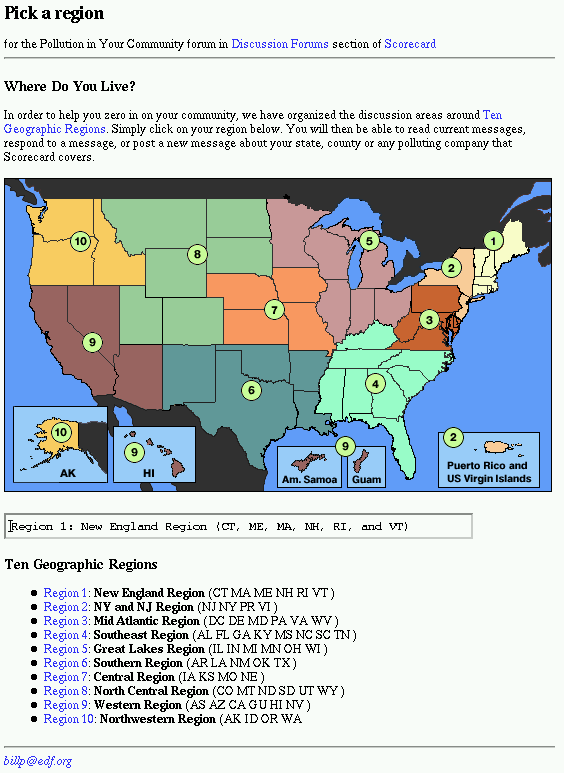
Feature of Note: Geospatialization
All the environmental data and discussion forums in
Scorecard are organized by local
region, so users can discuss pollution issues
with other users in their neighborhood. The capacity
to organize discussions by geographical region
is now a feature of the Community Toolkit.
Geospatial discussions are
the format to choose if you want to organize a community
discussion that centers around issues important to
a local geographical area. Perhaps it is the best way
to get virtual communities to organize and galvanize the action of
old-fashioned neighborhood communities.

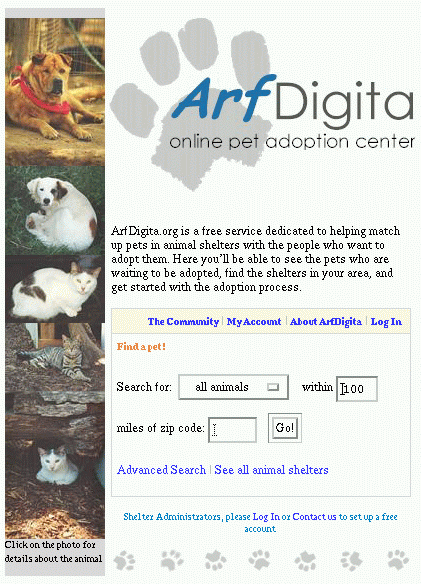 The Site: ArfDigita.org was a site built by students
in a web design class Philip taught at MIT. Its purpose is to
help
match up pets in animal shelters with the people who
want to adopt them. The hope is that it will help animal lovers
find their perfect pet and animals find good homes, without
burdening the animal shelter's resources unduly.
The Site: ArfDigita.org was a site built by students
in a web design class Philip taught at MIT. Its purpose is to
help
match up pets in animal shelters with the people who
want to adopt them. The hope is that it will help animal lovers
find their perfect pet and animals find good homes, without
burdening the animal shelter's resources unduly.
Feature of Note: Image Uploading
This is an innovative application of the image uploading feature. Shelters can upload digital images of the animals currently available for adoption. The images are displayed when a user searches for an animal. Also, random selections of images are displayed on the top page.
When this system was being built, before the image uploading feature was
added, Philip quizzed the authors: "What is the most valuable information
you have in your database?" The authors couldn't say, but the answer
Philip had in mind was: "All the cute pictures of all the cute animals."
Even though Arsdigita leaves all the issues of graphic design to
their customers, they do not ignore the power of images. In particular,
they are ready to take advantage of situations where user-supplied images
are useful. This is a
dramatic example where user-entered images enhance the function of service.
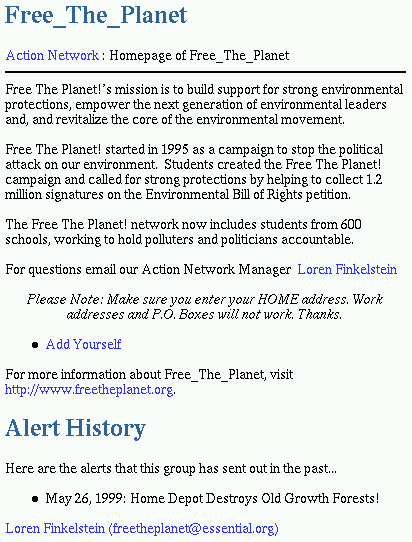 The Site: The Action Network is a site built
to help people influence policy decisions important to them.
Philip describes the design of this system in more detail in the
Chapter 16
of his book. Here is the explanation the site itself gives of its purpose:
The Site: The Action Network is a site built
to help people influence policy decisions important to them.
Philip describes the design of this system in more detail in the
Chapter 16
of his book. Here is the explanation the site itself gives of its purpose:
WHAT IS THE ACTION NETWORK?
The Action Network connects you with the policymakers who shape your world. With a single click,
you can weigh in when it counts, sending key messages to policymakers before they make their
decisions. You pick the organization or organizations you want to work with and the issues you
care most about. After that, the Action Network does the rest. You will be notified by e-mail when
a letter from you will make the difference and you will also receive a brief draft letter to help you
express your thoughts. With a single click, your hand-crafted letter is on its way to one or more
key policymakers. The Action Network makes getting involved as easy as checking your e-mail.
So, don't just watch from the sidelines! The power to change the world is only as far away as your
computer. Join The Action Network now! Sign up today - by joining any of the groups participating in Action Network!
 YOU CAN MAKE A DIFFERENCE!
Can one letter from you really influence an important decision? Absolutely! Many policymakers
never hear from constituents before making their decisions. Sometimes, in fact, as few as 5 or
10 letters can persuade a state representative to reverse his or her position. When you join the
Action Network, however, you join thousands of other like-minded activists who will also be
responding to our alerts. So, while it's true that a handful of letters can make a difference, the
Action Network frequently generates hundreds (and sometimes thousands) of letters,
amplifying your message many times. Read about some real world examples
of how the Action Network is making a difference today.
The system displays an innovative use of the email alerts capability
of the Arsdigita Toolkit; it isn't merely helpful, it could change
the world.

GuideStar is an initiative of Philanthropic Research, Inc., a 501(c)(3) public charity founded in 1994. GuideStar's mission is to help improve the effectiveness of the nonprofit sector through the collection and presentation of exhaustive information about nonprofit organizations.
Over the next ten years, GuideStar envisions the evolution of an increasingly efficient nonprofit marketplace where:
For more information about GuideStar, see Frequently Asked Questions About GuideStar.
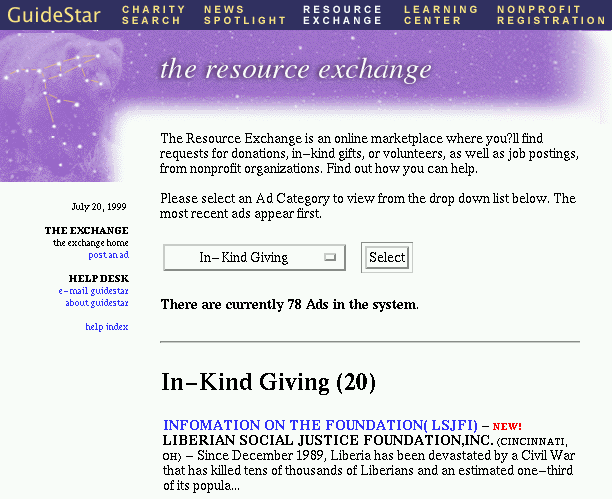
Feature of Note: Classified Ads.
Guidestar also runs a classified ad system for its member charities. Charities can post needs and get help from of the audience of users already disposed to take interest in the activity of nonprofits.
This system is very similar to the general classified
ad system included in the ArsDigita Community System Toolkit.
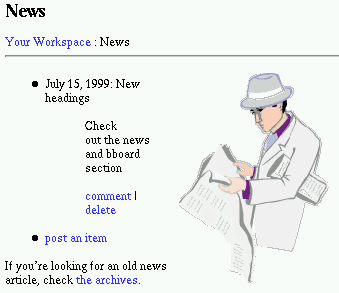
Feature of Note: News
Every community system contains
a news section like this one in which members can announce recent events
or subjects of of interest to them.
The LaSalle Banks
Chicago Marathon
Virtual Training will
guide you to the
finish line on
October, 24, 1999.
The LaSalle Banks
Chicago Marathon
and Do It Sports has teamed up with Senior
Runner's World writer, Hal Higdon to bring
you a training program complete with
schedules, daily training logs and analysis,
bulletin boards and daily tips.
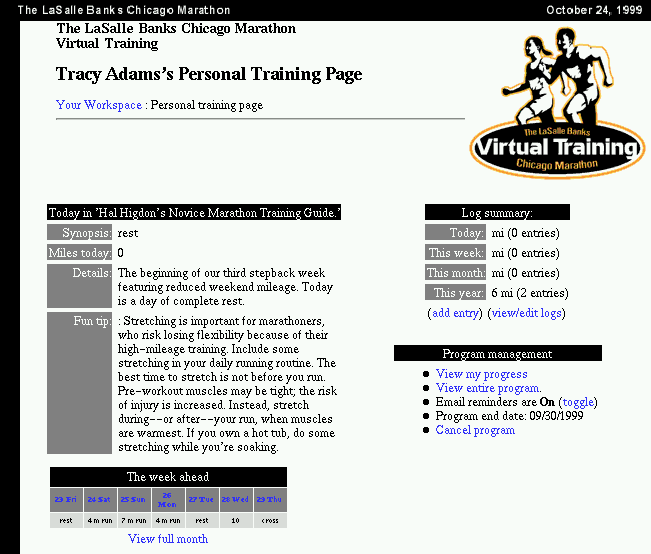
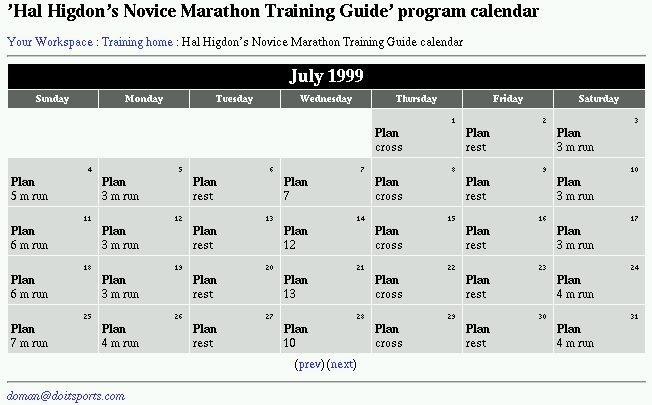
Feature of Note: Calendar Widgets
Programmers at ArsDigita built a special
calendar display widget for this site that is now part of the standard
community toolkit.
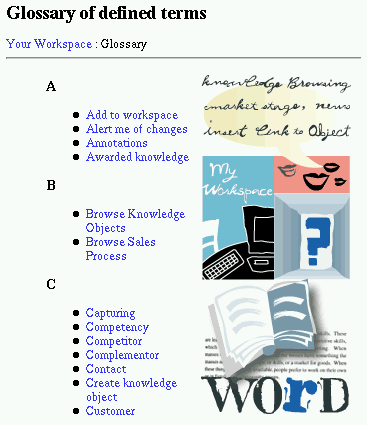
Feature of Note: Glossary
A complicated knowledge management
site contains many concepts that will be confusing to first time
users. Therefore Sharenet commissioned ArsDigita to build a glossary
system for their site, so confusing terms could be defined in one
centralized location. This capability has now been added to
the generic community system.
I founded ePLAY with a singular mission-to provide children around the globe with a safe Internet community where they can play, learn and connect with each other. My hope is that children will learn about the world and each other through ePLAY's characters, stories, games, and activities, which bring world history and culture to life.
ePLAY's Web site is designed for children ages 8-12 and is free of charge. The content changes frequently. And, our rich on-line and off-line activities appeal to the various ways that children learn and play. Click on Our Research to find out more.
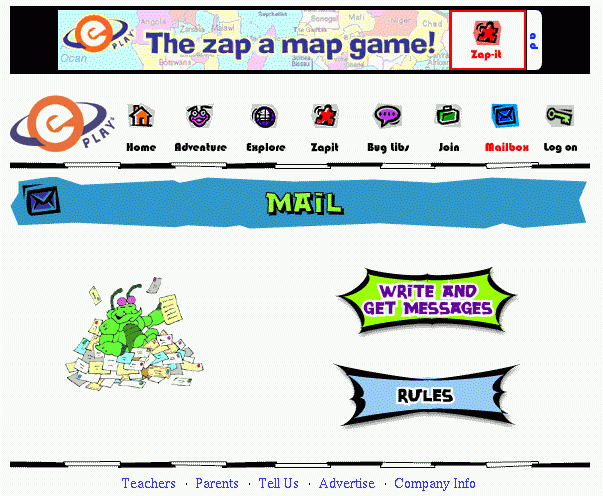
Feature of Note: Ad Server
The Arsdigita Community System includes an adserver module, which
we can see in action at the right.
Philip explained the rationale for including an adserver:
"Back in 1995, banner ads were the cornerstone of Internet
entrepreneurs' dreams. Now people recognize them for what they are:
mostly an annoyance. So why do we include an ad server in the
ArsDigita Community System? Because it is too painful to watch
publishers shell out $50,000 for packaged junkware ad servers that don't
work." Actually, even if one has no hopes of making money with it,
it can be fun to use the adserver for the purpose shown
in the example to the right: to entice users to check out another
portion of the site.
