In a closet inside your house, you are breaking the law. You are growing marijuana -- a serious federal crime -- and selling it to your neighborhood customers. In the closet, you have set up several planters of marijuana, which you supply with water as well as round-the-clock heat and light, using high-intensity "grow" lamps. The light is not visible from outside the closet.
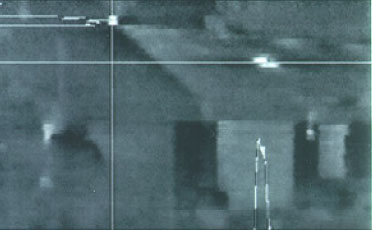
Meanwhile, Officer Jones of the local police suspects that someone in your neighborhood is illegally growing marijuana in their house. Jones knows that the heat from indoor grow lamps often heats up the grower's roof, which then radiates infrared light that is normally undetectable. Jones purchases an Agema Thermovision 210 -- a special digital camera that works not in the visible light spectrum, but in the lower-frequency spectrum of infrared light. He drives through your neighborhood at 3 a.m., taking infrared pictures of all the houses. When he gets to your house, he sees this:
For the first round of the rotisserie, answer the questions:
2. Using the Supreme Court's rulings in Katz v. United States, 389 U.S. 347 (1967) and Terry v. Ohio, 392 U.S. 1 (1968), argue your position persuasively in seven to ten paragraphs.